
Approach strategies for entering new markets, powered by the same platform data.
Markets is the newest layer of the platform — where Ecosystem tells you who's in a region and Data lets you query it, Markets tells you how to move into one. Launching late 2026 or early 2027.
It scores any adjustable geographic boundary.
State, county, region, metro, or single city — not just one fixed granularity. Most existing tools in this space do a poor job of letting you adjust the boundary, forcing you into a single city view or a single fixed unit. Being able to zoom the same scoring model from a whole state down to a metro or a county is a real differentiator.
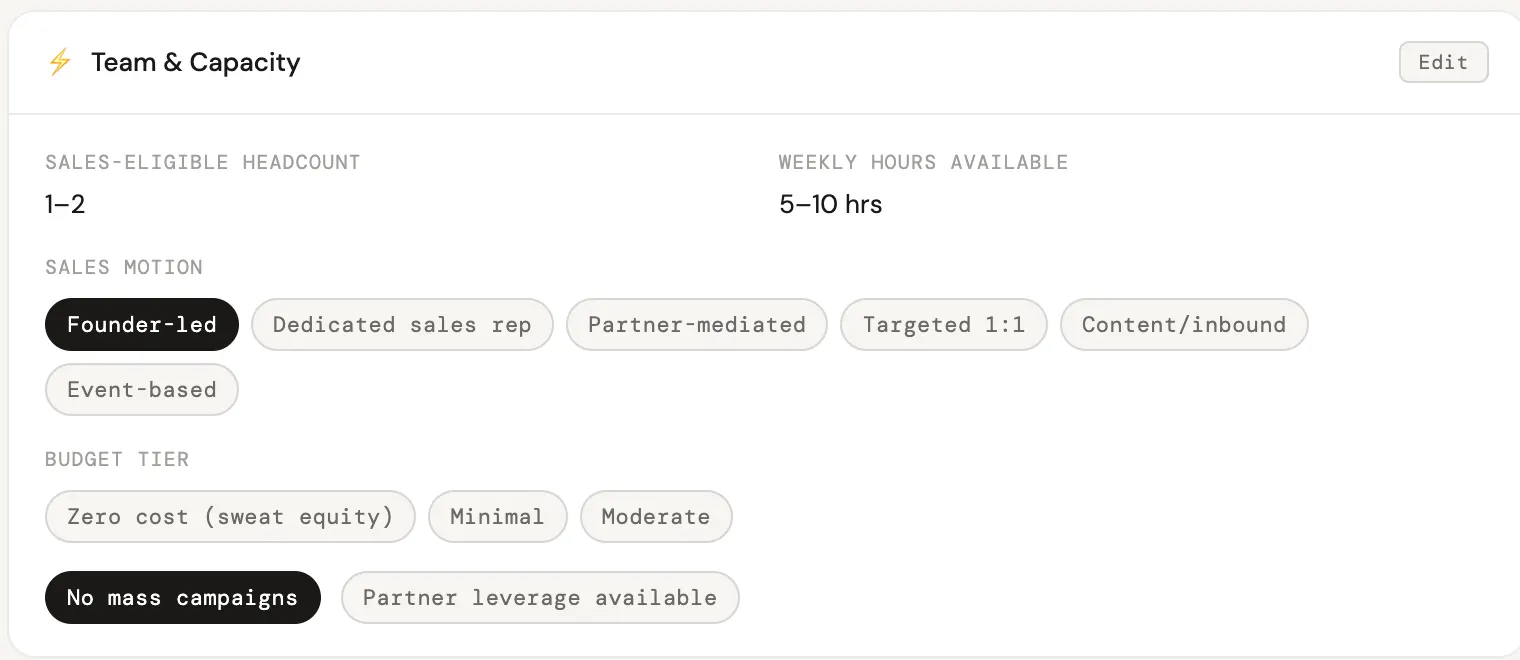
Scored for your actual bandwidth, not a generic team.
Before scoring a market, the tool captures the requesting team's own execution capacity — sales-eligible headcount, weekly hours available, sales motion (founder-led, dedicated rep, partner-mediated, targeted 1:1, content/inbound, event-based), and budget tier (zero cost/sweat equity up through partner leverage available). This is what lets the launch strategy and sequence stay realistic for the team's actual bandwidth rather than generic.
What it produces, per region
Overall score + sub-scores
An overall score out of 100 plus weighted sub-scores: ecosystem density, mission alignment, customer potential, existing-competitor/"whitespace" gap, inbound signal, investor narrative, growth-plan signal, and feasibility.
Launch verdict
A plain-language launch verdict — "Map it now," "Warm approach," "Back burner," or "Build first — wait" — with the reasoning behind it.
Ecosystem scan
Anchor organizations already active in the market, notable gaps/whitespace, underserved populations, and active initiatives.
Launch strategy
A staged launch sequence (e.g. an 8–10 week plan), messaging hooks, a public-launch angle, and risk flags.
Outreach sequence
Specific target orgs and contacts, a rationale for each, a tailored ask, and a ready-to-use opening line.
Draft cold email
A ready-to-send draft cold email.
Economic value estimate
Estimated addressable orgs, build cost (dollars + person-hours), projected year-1 pipeline, 3-year LTV, gross profit, and ROI — each with a stated confidence level and named caveats.